Giselle
Dear Reader,
I won’t belabor an apology for my prolonged absence from writing. If anything, absence has a way of sharpening attention…and this evening inspired me to attract yours once again. What called on me to rouse you from your social media-scrolling daze, you ask? The answer lies herein…
This is my first time writing about ballet, though certainly not my first encounter with it. I took ballet lessons for years as a child (I quit one year into pointe–not for me), and have seen professional performances in Germany and France, as well as here in Seattle. For me, a ballet performance takes me not only out of the reality of daily life, but seemingly out of my own body as well. I fantasize that I am moving with the same lithe grace I see, experiencing the physical rush of all the jumping, arching, and stretching… Ahem, what I mean to say is that such performances are truly transporting for me, and I relish them. Perhaps this is what some people feel when they watch football.
I had dressed for my first viewing of Giselle with anticipation of the spectral drama I was about to witness. I wore an airy yet minimal, spring-appropriate gown, fluid enough to just echo the tone of the show, without becoming theatrical. My neck and wrists were spritzed with Bal d’Afrique, a perfume I received as a gift, that I wear in many situations. I chose this fragrance for its easy refinement and understatement. In a crowded theater, elbow to elbow with strangers (someday I’ll have a box seat!), that restraint from overpowering one’s neighbors’ olfactory senses is its own form of elegance.
I brought my gold-toned Eschenbach opera glasses, which were also a gift, and one that brings me more and more pleasure each time I use them. Ballet reveals itself in detail, and I prefer not to miss what’s deliberately placed there. Through the glasses, I caught the finer elements that would otherwise be lost at a distance: small gold ribbons woven into costumes, the delicate fairy-like wings worn by the Wilis, the varied textures of sumptuous fabrics–tulle, satin, and others layered with care–and, just as importantly, the facial expressions of the dancers (yes, they are really acting, and not just dancing!).
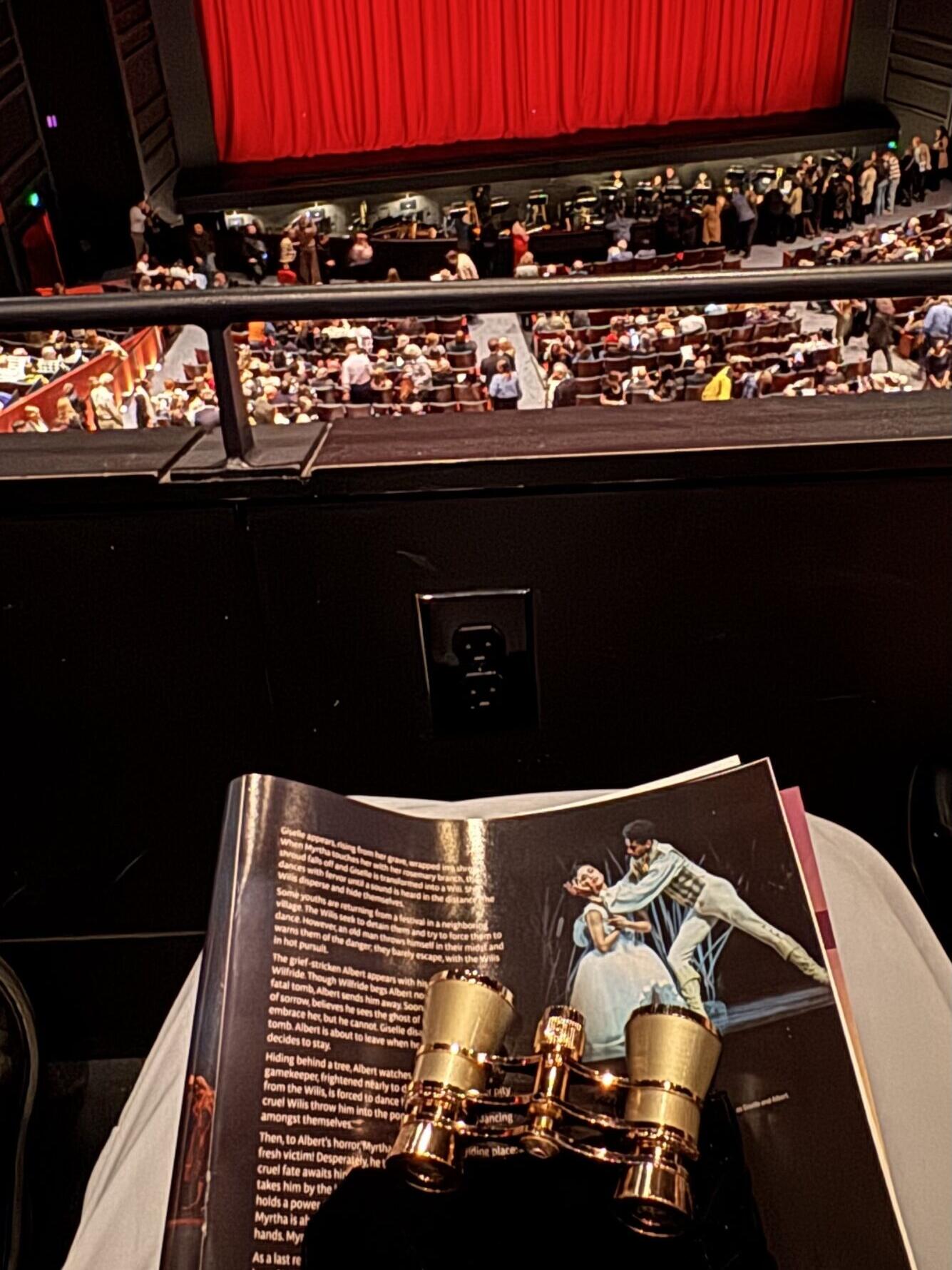
In my haste to reach my seat before the orchestra started, I had forgotten to grab a program, so the first act unfolded, like a mysteriously found origami crane, without my comprehension. Watching without a guide had a certain charm to it, though, with nothing mediating between the performance and interpretation.
This production of Giselle understands something essential: not everything needs to be wrestled into contemporary relevance to feel alive. Rather than bullying its aesthetics into the present, the artistic director trusts the work to stand on its own, with production values I feel the original 19th-century audience would have enjoyed. Sometimes, traditional is best.
The plot of Giselle itself is…structurally straightforward. A vibrant, beautiful young woman, a charming but deceptive man, emotional consequences, and a second act populated by supernatural women sharing a very specific grievance. It isn’t a story one scrutinizes for realism. Ballet isn’t asking for belief, anyway. It merely asks us to dream in unison for a while.
To my left sat a woman with tiny binoculars of her own, quietly focused the entire time, like myself. To my right, two women who spent the few minutes before the curtain rose somewhat concerningly breaking down the plot into short, snarky little fragments. Their commentary didn’t add much beyond volume. It was a small irritation, but one that thankfully dissolved as soon as the performance began.
Ballet isn’t asking for belief, anyway. It merely asks us to dream in unison for a while.
Seattle audiences, more broadly, have a particular way of expressing enthusiasm. At the slightest swell in tempo or the recognition of a solo taking place, the room responds–immediately, and often loudly. On one hand, it’s genuine warmth and enthusiasm, which is lovely! On the other, it can feel less like a response to what’s happening on stage and more like a desire to be heard as an individual within it. I understand that historically, classical music and ballet audiences could get pretty rowdy. But I would prefer that contemporary audiences hold back from yelling “Woo!” every chance they get, since this art from over a century ago is so rare (and honestly difficult, for most people) to experience in our age. In a nutshell: I don’t want to miss a thing. So I wish people could be content with clapping, during the performance (go wild at the end, sure). I simply don’t like being taken out of the special moment by random people’s guttural or high-pitched yelps. *steps down from soapbox*
Still, I, for the most part, felt quite immersed in the performance.
Giselle‘s staging was lush without excess, cohesive without being monotonous. Both village scenes and the Wili’s lair were all rendered with a familiar fairy tale style that fleshed out the environs while allowing the dancers to remain the focus.
Giselle’s dancing was beautifully controlled, yet ferociously free, reminding me of a diamond flickering in sunlight (or moonlight). Her dark hair and bird-like physique made me swear a few times I was watching Audrey Hepburn pirouetting and leaping about. Though my glasses showed me otherwise, the resemblance physically, and in the way she moved, was striking. I am reminded that Hepburn had originally wanted to be a ballerina and not an actress. Note to self: watch Funny Face (to see her dancing).
Albrecht (anglicized to Albert in my show program), Giselle’s deceptive love interest, played his part with equally vivacious charm. His manner was boyish yet poised, his movements were technically refined, and I might have developed an instant crush on him. He moved with ease and purpose, and seemed to have great chemistry with the dancer who played Giselle. But, all too soon, Albrecht’s deception was exposed by a jealous guy ironically named Hilarion. Giselle, in her shock and disbelief, goes insane, and collapses dead from a broken heart. Why she was not happy to learn that Albrecht was actually a Duke, escapes me still. A stickler for the truth, that one.
Act I, like Giselle, then met its end. Intermission, inevitably (for me), meant champagne.
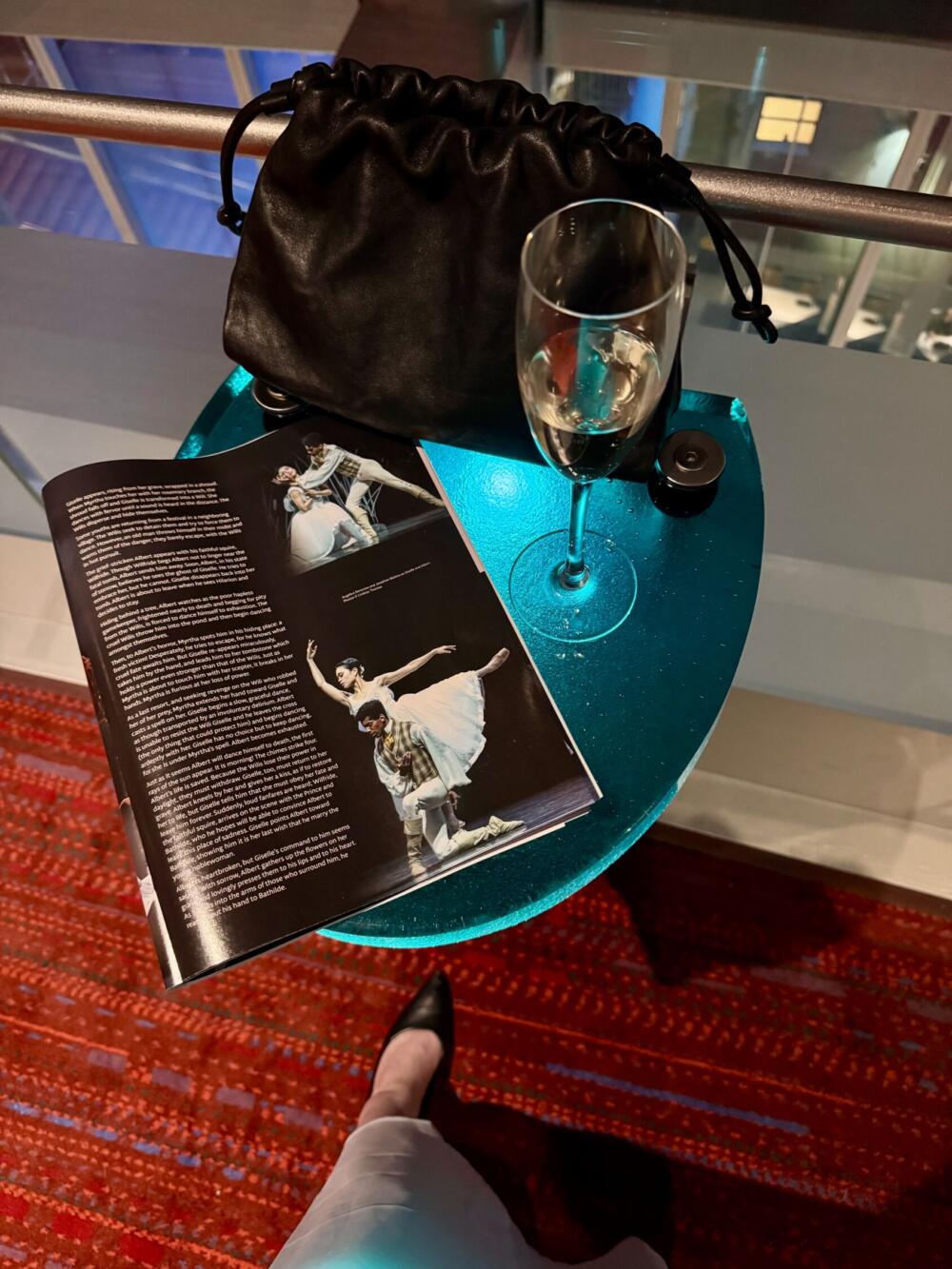
The concession bartender offered me the choice of either a plastic cup that I could take back into the auditorium, or, the only sane choice, a glass champagne flute. I spent the interval people-watching, using my phone only to take a quick photo. I enjoy taking in the clothing, posture, and small gestures of other attendees, and forming quiet hypotheses about the lives around me. It’s one of the more reliable pleasures of an intermission.
When we returned, the theater felt warmer–literally. People had been moving, drinking, and circulating during the break, and our bodies were now giving off heat. It lent the room a faintly animalic quality—not in terms of odor, but temperature. A reminder that, for all the dissociation from reality happening during a show, a theater is still a space filled with living, breathing bodies. I was getting more of the base and mid notes of my row mates’ perfumes, and the air itself just felt…anticipatory. I would end up counting three loudly dropped drinks during the second half.
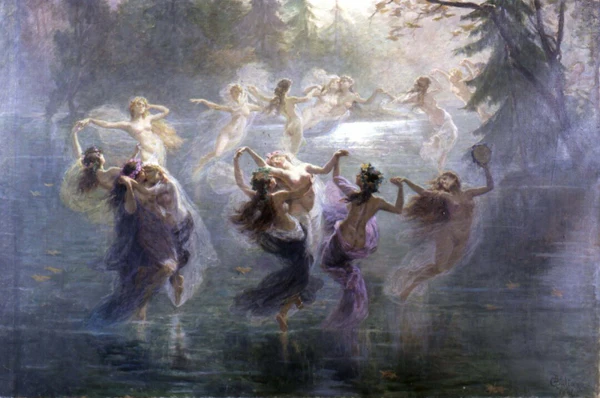
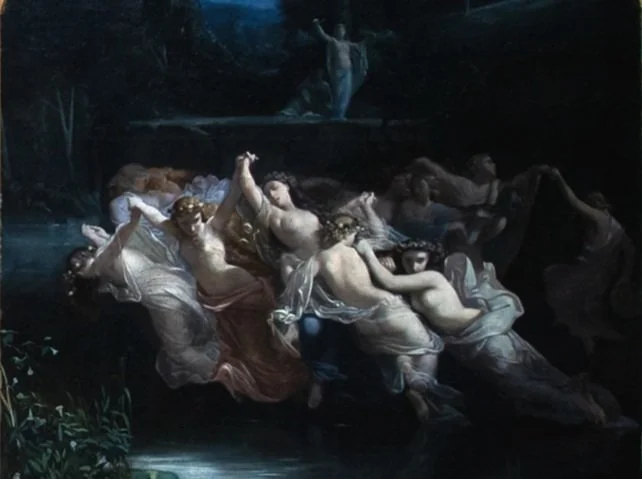
Act II began, set in a forested graveyard. The Wilis, in Giselle, are a group of ghosts who haunt a cemetery together. The story goes that they are the apparitions of women who died of heartbreak before their wedding day (a cautionary tale for the ages, to be sure). They rise from their graves at night, to dance, as one does when heartbroken. If a hapless man strays into their presence, they encircle him and–you guessed it–dance him to death.
Myrtha, the beautiful yet subtly terrifying Wili queen, appeared first, gliding alone across the stage with a flat, unearthly precision. For a moment, partially obscured by grass, it was difficult to register how she was moving at all. There was no visible effort, no clear step–just a slow, smooth, hovering passage from stage right to stage left. It was quietly unsettling. Very well done.
The rest of the Wilis followed, all dressed in shimmering white tulle. They were cool, exact, and striking in their uniformity. Their movements created the impression of suspension, as though gravity had loosened its hold. After a fluttering entrance, they assumed their places in a double line formation. What followed was a moment of pure stagecraft, as their sparkling, translucent shrouds slowly floated up and away, until they vanished without explanation. Suddenly, I realized that the dancers had been dancing with fly lines attached to their costumes, and I appreciated the challenge that might have posed to them. The ghostly movement was so unexpected and otherworldly that I gasped aloud, and many “oohs” were murmured around the room.
In tandem with watching Giselle‘s story unfold, my internal experience of the show gave me much to ponder. For background, let’s just say that there is a particular low-grade sadness that tends to underlie daily life in much of the US now. The mental accumulation of absurdly tragic headlines, endless fragments of troubling (mis)information, and a permanent awareness of many things not going particularly well in the world. It settles in quietly, insidiously, while scrolling Twitter, and also often enough in real life when seeing problems manifest first-hand.
Sitting in the theater at the start of Act I, watching something so carefully arranged around grace, lightness, and beauty, I noticed a slight delay in my emotional engagement–an adjustment period. As though my mind needed a moment to remember how to meet that kind of experience without filtering it through the muck of everything else.
It was a useful reminder for me that one can’t arrive at moments of beauty in the same mental posture used for absorbing bad news, and expect the experience to register fully. A small but intentional re-calibration is required. A conscious release of tension, when it no longer serves a purpose.
A small but intentional re-calibration is required. A conscious release of tension, when it no longer serves a purpose.
Ballet makes a compelling case for that shift. The dancers’ discipline is real, their physical strain undeniable. And yet what reaches the audience is a stunning apparition of ease, a moving fantasy of a human ideal. The transformation, the state of suspended disbelief, is the appeal. Experiences like this are so touching, that they remain with us, even if only as a lingering, mysterious desire for things to be…elevated. For our standards to rise. For us to re-learn what it is to dare, to seek a richer life experience.
I left the performance not so much affected by the romantic story line as…adjusted…by the entirety of the experience. And so I decided to write about it. I’d like to express my thanks again to the gentleman who gifted me my ticket to see Giselle. It really means so much to me, to know that someone wants me to experience the pleasure of taking in great culture and art.
So. Have you seen Giselle? Or are you simply curious? In the end, I think it’s very important for us all to find moments of indulgence, where we prioritize nothing but lightness, freedom, and fantasy. Perhaps, for you as well as for me, it is the missing link between our hectic daily lives, and what we would like them to grow more into. Inspiration is the seed of everything good. Or at least everything interesting. Let’s take it where we can.
Phantasmagorically yours,
Annie